



-
Scroll Page | Stop Scrolling
 The picador - Pablo Picasso
 House in the field - Pablo Picasso
 Plaster male torso - Pablo Picasso
 Academical study - Pablo Picasso
 Bust of young man - Pablo Picasso
 Female nude from back - Pablo Picasso
 The barefoot girl - Pablo Picasso
 The old fisherman - Pablo Picasso
 Artist's mother - Pablo Picasso
 First Communion - Pablo Picasso
 Head of a child - Pablo Picasso
 Portrait of aunt Pepa - Pablo Picasso
 Science and Charity, 1897
 Head of a Man in El Greco style, 1899
 La chata, 1899
 Lola, 1899
 Portrait of Casagemas, 1899
 Portrait of Josep Cardona, 1899
 A spanish couple in front of inn, 1900
 Bullfighters and bull waiting for the next move, 1900
 Embrace, 1900
 Fairground, 1900
 Gypsy in front of Musca, 1900
 Lovers of the street, 1900
Before any trip to an art gallery or museum, it is wise to bone up on your art knowledge.
At
some point in our education almost all of us took a course in art
appreciation, usually at the same time when our grade point average
needed a turbo-boost — art being the easiest "A" in your academic career
— after Finger Painting 101. Art exams have two parts: “Name This
Artist” and “Comment on this Work.” Identifying artists is easy because
of a long-held artistic tradition of signing one’s work. (It's a good
idea to bring a magnifying class to the exam.) The comment section is
simple because there are no right answers. Only the most arrogant
professor would insist there’s no way you could see a cat pondering the
universe in a Jackson Pollock painting.
The
history of art is a sequence of Periods, called that because the
artists of the time felt the technique they practiced was the final word
in artistic expression. In the words of the famous artist Joan Miro, “Thisis
Art. Period!” These movements had specific names such as Expressionism,
Pointillism, Impressionism, Cubism and enough other -isms to evoke
Excedrin Headache No. 4. There’s also Renaissance Art, Baroque Art,
Modern Art, Paint-by-the-Numbers Art and, Self-Expression.
Individual
artists had their own periods, spelled with a small “p” to evade
charges of artistic arrogance — like Picasso had his blue period and his
pink period because it’s a lot cheaper to buy paint by the tank
carload. Picasso would buy 20,000 gallons of blue paint and when he had
finished using that he’d buy 10,000 gallons of pink or whatever color
was on sale. No one knows why Picasso was such a penny pincher as he
marked his work up 3 zillion percent over the cost of materials. This is
known as artistic license.
Art
started in caves. To break up the monotony of depressing gray cave
walls, early artists drew charcoal pictures of bulls with horns, men
with spears and mothers-in-law with mustaches. Television was later
invented as another solution to the bare-wall problem.
Initially,
art painted on walls had a serious drawback: if your picture was a
little off plumb, you had to walk around with your head slightly askew.
This plumbing problem led to the invention of painting on canvas
stretched over a frame. Today, if a picture is crooked, a flick of the
finger rights it.
In
terms of materials, after graphite and colored chalk came watercolor,
followed by oil paint, which remained popular until OPEC was formed. At
that point, many artists shifted to acrylics, which have two advantages:
brushes are easier to clean and, being oil-free, they don’t adversely
affect our nation’s balance of payments or endanger the habitat of any
Alaskan wildlife. Today, it’s acceptable to use anything as artistic
materials: garbage, sticks and stones, old clothes, automobile parts,
recycled leftovers and shredded divorce settlements.
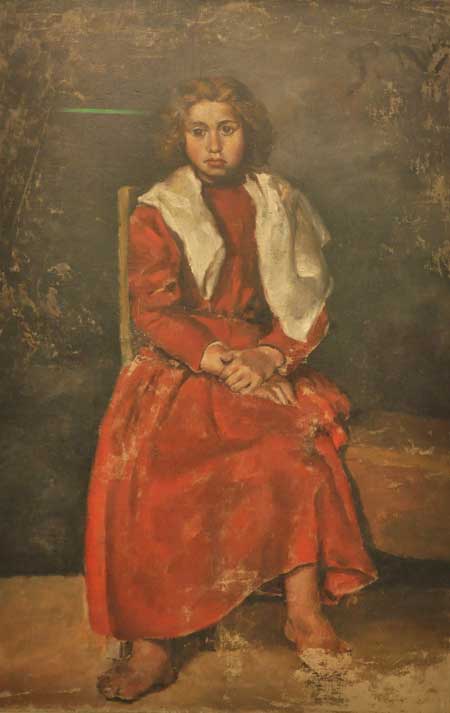
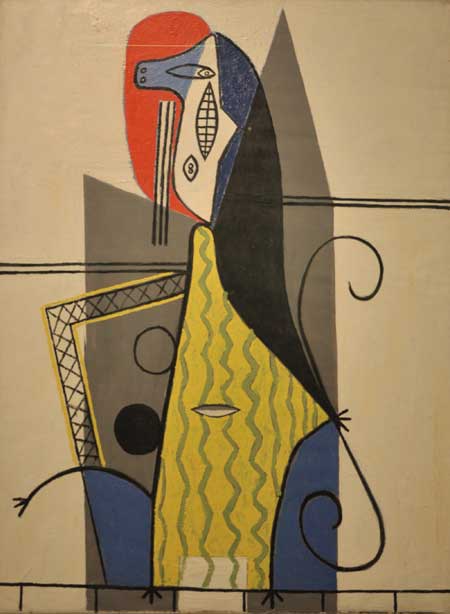
a girl barefoot sitting the middle of the screen, staring ahead, his hands folded put in the red dress on, realistic clothing folds and facial luster, as if Raphael’s true mass; another picture, a woman’s body is distorted deformation of the head and chest were simplified as spherical, facial features, it is difficult to identify. With figurative and abstract, planar and three-dimensional, two painting styles and even antagonism, it is difficult to believe from the same handwriting – renowned modern artists of the 20th century, Picasso.
for this two “barefoot girl” and “take the red armchairs woman”, as the exhibits of the Paris National Picasso Museum of Art from the Museum Collection “is now on display at the Hong Kong Heritage Museum from May 19, the public can to see the artworks.
“‘change’ throughout Picasso’s life, his daring, holding absolutely open attitude to every kind of art style, his art is revolutionary.” Picasso Museum of Art curator Anna • Balda Sally news agency reporter said that the hope that the public can see and learn this through the Hong Kong exhibition.
Life of Picasso created more than 30,000 works of art, Picasso Museum of Art collections of these, more than 5000 pieces, the exhibition in Hong Kong, 49 paintings and seven sculptures, traces the artist spans more than 70 years creation, covering the period of work of the blue, pink, original, three-dimensional, neo-classical, surreal and so on.
In addition to the works of art, the exhibition at the same time display dozens of Picasso’s private file photo, video, and audio data, including the photographer Robert Capa Picasso and her lover to capture the “decisive moment”. Curator Anna also remind visitors pay attention to paintings to the wall top, there is the interpretation and perception of Picasso created, such as “For me, creation is the sum of the damage. I paint immediately after tearing it to destruction”.
“artistic language, Picasso academic, original paintings, Africa and Oceania painting ‘dialogue’, he has been in-depth study of Chinese painting is now in the 21st century, we still need to learn from Picasso’s open Baarda Sally, Anna, comments, and Picasso himself says “I have no style,” echoed.
Picasso said, “I’m painting like someone else to write autobiography, his work not only reflects the changing times and the impact of social, also outlines of a friend, lover, father, artist and celebrity equal to the life of a trajectory. In the pre-show, heard six of the seven lover of Picasso “hiding” the Hong Kong Exhibition of paintings, the media showed great interest.
the exhibition publicity materials cover the selection of a portrait, a strong color contrast, highly visual impact, the sitter is one of Picasso’s lover Dora • Martha. Interestingly, the same in 1937, Picasso was just another lover Mary portrait. The two paintings are now adjacent juxtaposition of “peaceful coexistence”.
the exhibition has become the city event. Its Impressionist exhibition in 2008, organizers also expect a two-month exhibition period, is expected to refresh the 300,000 Hong Kong exhibition attendance the highest.
Hong Kong Heritage Museum curator Zheng Huantang pointed out, this is Hong Kong has always been the largest and most diverse exhibition of Picasso, 56 exhibits a total valuation of $ 6.7 billion Hong Kong dollars, most of them never left the artist’s studio and museum. The traveling exhibition at the Picasso Museum of Art planned specifically for the Asia, following Taipei, Shanghai and Chengdu, Hong Kong is China’s last leg. “The next 30 years.” Curator Anna seemingly joke word, points to the exhibition of a rare opportunity.
A talented artist, Pablo Picasso was one such person who was way ahead of his time in terms of his creativity and thinking powers. These are aptly depicted in his stylized works. Here's a look at the timeline of Pablo Picasso, which notes down some important events connected with his life.
Pablo Picasso, the talented Spanish artist is known all over the world his Cubist style of painting. This highly talented Spanish painter was a draftsman and a sculptor as well. He founded many other various styles of painting. Today, Pablo Picasso remains to be an iconic figure for art students and art lovers all across the globe. Here is a look at the timeline of Pablo Picasso which makes a note of some of the important events related to his life.
Timeline of Pablo Picasso:
1881: Pablo Diego José Francisco de Paula Juan Nepomuceno María
de los Remedios Cipriano de la Santísima Trinidad Martyr Patricio Clito
Ruiz y Picasso, was born in Málaga, Spain. He had a series of names that
were given in honor of all the various saints and relatives. Born in a
middle class family, Pablo Picasso's father, Ruiz was a painter.1891: The entire family moved to La Coruña since Pablo Picasso's father was taking up a job as a professor at the School of Fine Arts.
1894: It can be said that this was the year when Pablo Picasso's career began as an artist in this period.
1895: Pablo Picasso's seven-year-old sister died due to diphtheria. Therefore, the entire family then moved to Barcelona. His father, Ruiz, had a transfer to the school of Fine Arts. This was the time when Picasso answered an entrance exam and impressed the jury at the academy, which also helped him to secure admission into the institute as well.
1896: Pablo Picasso painted The First Communion. This year, he also painted the Portrait of Aunt Pepa.
1897: Pablo Picasso set off on his own for the first time in his life. This was a time when he developed a tinge of Symbolist influence in his realistic works.
1900: Pablo Picasso first visited Paris. Paris was considered to be the art capital of Europe. This is where he met Max Jacob, a journalist and poet.
1901: Pablo Picasso along with his friend, Francisco de Asís Soler founded the magazine, Arte Joven (Young Art). This was when Pablo Picasso added grim cartoons that spoke about the state of the poor.
Between 1900-1901, Pablo Picasso's paintings contained shades of only blue and green. Other colors were used sparingly or only as support for the entire canvas.
1903: This was time when blindness was represented in most of Picasso's works such as The Blindman's Meal and the portrait of Celestina painted this year.
1904: This was the period which was named as the Rose Period (1904-1906) and one could see a use of colors such as orange and pink in his works. It is rumored that Pablo Picasso met Fernande Oliver this year. (Fernande Oliver was a Bohemian artist who appears in many of Picasso's paintings) This meeting and his relationship with her changed the style of his paintings, which was reflected in the colors used.
1907: Pablo Picasso completed his work, Les Demoiselles d'Avignon (The Young Ladies of Avignon) in France. This is one of Picasso's famous works.
1909: Pablo Picasso, known for the style called cubism, first developed it this year. The period between 1909-1912 is considered to be when cubism first took shape with the help of George Braque. Both these artists analyzed shapes and translated them into images with their creativity.
1911: Pablo Picasso's friend, Apollinaire was suspected and later arrested for stealing the Monalisa from the Louvre. This led to the arrest of Picasso as well who was questioned and later released as not guilty.
1912: Synthetic cubism was developed during this period. This was the time when collage was first used; portions of newspaper were used to create compositions.
1918: Pablo Picasso married Olga Khokhlova, who was a ballerina.
1927: Pablo Picasso had a secret affair with 17 year old Marie-Thérèse Walter. His marriage was one that had constant conflicts for the past few years.
1937: His depiction of the German bombing of Guernica brought him much fame.
1939: From the period 1939 to 1940, The Museum of Modern Art in New York City held a successful exhibition of Picasso's work.
1944: Picasso had a relationship with Françoise Gilot, a young art student who ultimately left Picasso in 1953.
1967: Pablo Picasso made a small-scale model for a public sculpture (Chicago Picasso). This sculpture turned out to be the most recognized landmark in Chicago which was unveiled this year. Picasso refused payment for the same.
1968-1971: This was the period when Pablo Picasso's works turned out to be more creative and expressive although he did not really receive the kind of recognition he deserved. His works were criticized and it was only after his death, artists realized that Pablo Picasso had used neo-expressionism through his art. This was probably due to the fact Pablo Picasso thought way ahead of his time.
1973: This talented artist passed away on 8th April, 1973.
Slideshow
All Pablo Picasso artworks in chronological order

Pablo Picasso (1881-1973) once said: "Art is a lie that tells the truth." And although 48 oil paintings, seven prints and seven sculptures may be a drop in the ocean of the Spanish artist's 37,000 or so artworks, that's the number of original Picasso's that are on show from this month, the largest ever exhibited in Shanghai.
The Barefoot Girl
Cubist pioneer
This will be the first China showing for these works by one of the most creative artists of the 20th century and the founder of the Cubist art movement. The China Pavilion at Expo Park is playing host to these 62 masterpieces during the three-month exhibition. The works have been loaned as part of a fund-raising effort on behalf of the works' custodians at the Musée Picasso (Picasso Museum) in Paris, which is financing a major extension of its premises.
For ordinary art lovers in Shanghai, it affords a rare opportunity to appreciate some of Picasso's most important works without having to leave the city. So far, attendance numbers have averaged 3,000 people per day at weekdays and up to 10,000 per day at weekends, according to organizers.
Woman in an Armchair
Picasso the master
Occupying a total exhibiting space of 18,000 square meters, the show is composed of seven sections displaying Picasso's works throughout his varying creative periods. There are another eight sections featuring 50 photographs documenting Picasso's life, as well as his own photographic works.
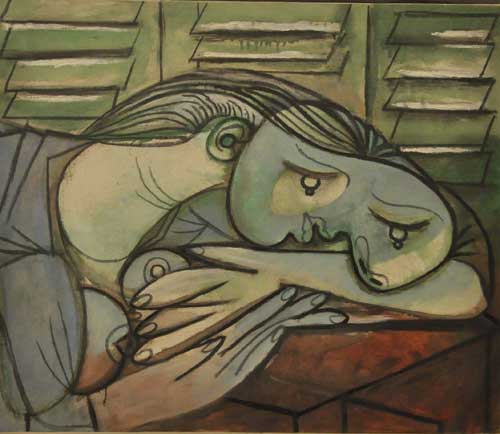
Picasso's artistic periods include the Blue Period (1901-1904), the Rose Period (1905-1907), Analytic Cubism (1909-1912) and Synthetic Cubism (1912-1919). Among Picasso's early works, The Barefoot Girl was finished when the painter was only 14 and remained one of his favorite pieces. Other female portraits feature a number of his lovers including Portrait of Dora Maar and Sleeping Woman with Shutters. In the abstract work Woman Sitting in a Red Armchair, Picasso used exaggerated and distorted shapes and strokes to express feelings of pain and suffering. In the painting Paulo with Pierrot Picasso painted his son dressed as a clown.
Walking from one room to the next, visitors are able to view Picasso's works chronologically. Between each section there is a dividing wall featuring a portrait of the artist at the time, and an introduction to the works contained therein. There are also photos from his daily life.
Apart from an audio guide to rent and a free guided tour every hour, the exhibition organizers have also arranged a series of free lectures from November onwards. Fine art experts will be invited to talk about Picasso's art and their personal interpretation of his works.
Sleeping Woman with Shutters
It was back in 1983 that the first Picasso paintings were exhibited in Shanghai. And 28 years later, the arrival of these 62 works is thanks to the fact the same pieces were recently shown at a Picasso exhibition in Taiwan, according to Xie Dingwei, curator of the exhibition and general manager of Shanghai Tix Media which organized the show.
"When I heard the exhibition would be stopping in Taiwan on its world tour, I proposed the idea of holding an exhibition in Shanghai to the Musée Picasso via the organizer in Taiwan. And we finally achieved it," Xie told the Global Times.
The exhibition is entirely commercially-operated, with no government funding, and the fee paid to the Musée Picasso for the works came to more than one million Euros. The money has all been provided by sponsors and partners. "We expect anywhere between 500,000 and 600,000 people to attend during the three-month exhibition," said Xie. He added that merchandise at the exhibition shop would also help towards covering the fees.


沒有留言:
張貼留言